Your inner strategy is just as important as your outer strategy.
A budget laid on top of an old money story doesn't survive the month, so Financially Whole starts with your story and finishes with your numbers.
Understand your money story · Build your budget · Plan your wealth
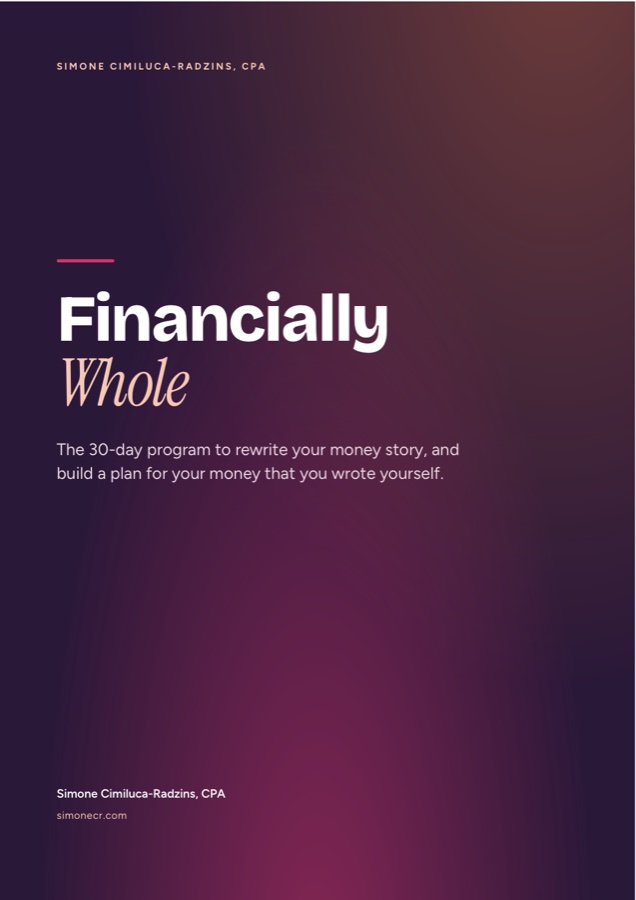
Financially Whole · a 30-day money program from a business and finance expert
Financially Whole will show you how to find the beliefs that have been quietly setting your prices and your limits, and you'll be able to replace them with a plan for your money in your own handwriting, which will help you make money decisions with a lot less stress.
You'll get thirty days of guided work, one short theme a day, with prompts you write on. It's one payment of $47, and it's yours to keep.
If this sounds like you
Say you run a small design studio. You have three clients you like and your work is good, but your rate hasn't moved in two years. You know what you should charge, and you know you meant to put money aside every month. You've been meaning to sit down with your numbers since spring, and when a client goes quiet after you name your price, you drop it before they've said a word.
That isn't a discipline problem, and it doesn't mean you're bad with money. The gap sits between what you know and what you do when money is on the table, and it comes from beliefs you picked up long before you ran a business.
Think of the thermostat in a house. You can open every window on a cold morning and the rooms will warm up for a while, and then the thermostat quietly pulls the temperature back to the setting it was given years ago. Money works the same way, because a new plan warms the room and the old setting keeps pulling you back to what feels normal.
There's a whole day in Financially Whole on that setting, which I call your income thermostat, and you'll learn how to move it. Where do you think your own thermostat is set right now?

Why I built Financially Whole
I grew up without much money, and that's a big part of why I went into business and finance. I've spent close to 20 years in business advising, starting at PwC, 21st Century Fox and Capgemini, and for more than a decade I've worked on my own with startups, small businesses and entrepreneurs.
The owners who called me were usually earning well and still running out of cash, or their books were a mess, or they were getting ready to raise money. What they wanted was peace, profit and a lot less chaos.
And nearly every time, before we could get anywhere with the numbers, we had to talk about what money meant to her, because those beliefs had been setting her prices and her limits long before any math did. So I built Financially Whole to do both halves, in the order that holds.
Simone Cimiluca-Radzins · CPA · Keynote speaker · Lived and worked in 40+ countries
What I believe
A budget laid on top of an old money story doesn't survive the month, so Financially Whole starts with your story and finishes with your numbers.
Shame is expensive, because it uses up the energy you need for the next decision. There's a day on money shame written directly to women, with simple ways to steady yourself before a money conversation.
A plan someone hands you is easy to put down, and a plan in your own handwriting is one you'll keep. That's why you fill in every framework yourself.
How Financially Whole works
The order matters, because you can't rewrite a story you haven't found yet.
You'll define wealth across five areas, which are your wallet, your experiences, your attitude, the people who bring you love and your health, and then rate where you honestly sit in each one.
You finish withYour own definition of wealth, and an honest score for each part of your life
You'll write your financial legacy and take your why down three levels, because the first answer is the surface one and the third is the one that carries you through a hard month.
You finish withA financial why strong enough to hold on the difficult days
You'll go back to your earliest money memories and the household you grew up in. Seeing where a belief came from turns it back into a belief, because until then it's been running as though it were a fact.
You finish withYour money blueprint, written out where you can see it
You'll name your money fears and look honestly at the shame, and then you'll get practical ways to settle yourself before a money conversation.
You finish withYour fears named, and tools to steady yourself before you need them
Naming a limiting belief doesn't dissolve it, so you'll take yours through a sequence of questions that tests whether it's true at all, what it's been costing you, and who you'd be without it.
You finish withThe belief taken apart at the root, and your wealth declaration
You'll build out the version of yourself who has already done it, down to her values, her habits and her boundaries, and you'll name her. A decision is much easier to make when you can ask what she would do.
You finish withYour higher self, described clearly enough to borrow from
Then come the days on self love, boundaries, gratitude and forgiveness, because wealth built on self-punishment turns into burnout. From there you'll look at your own income ceiling.
You finish withYour income ceiling named, and the beliefs holding it there
You'll build a budget around the life you want, work out your monthly cash flow, calculate your net worth, put your debts in the order that costs you least, and set out your long-term plan.
You finish withYour budget, your net worth baseline, and a wealth plan
The thirty days
Back to your design studio, with three clients you like and a rate that hasn't moved in two years.
You write what wealth would actually mean for you, and it turns out to be time more than a bigger number.
You trace your discomfort about charging back to the way money was talked about at your kitchen table, and that belief stops sounding like a fact.
You name it, which is that you drop your price the moment someone goes quiet, and you learn what to do in the ten seconds before you answer.
You run your net worth for the first time and see that your costs are eating the share meant for building wealth, so you know what to change.
By day thirty you have the next seven days written down, and the first item is the rate conversation you've been avoiding since spring.
What's inside
Your first week
The bill doesn't arrive all at once, which is why this is easy to put off. It shows up as the rate you didn't raise, repeating on every invoice you send for the rest of the year, and as the savings you meant to start in January, and as the interest on a debt you could have put in a better order months ago.
And there's the part that's harder to count, because carrying money shame is tiring. It comes with you into your sales conversations, so you discount faster than you meant to, and you say yes to work when you'd decided to say no.
Forty-seven dollars is a small thing to test all of that against.
Who it's for
Start tonight
$47
That's about the cost of one dinner out, for thirty days of work and a set of tools you can come back to every year. You'll get access in your portal the moment you pay.
Get Financially Whole → Already a member of Women's Money Society? Financially Whole is included in your membership, so you'll find it in your library.Because you get access the moment you pay, all sales of Financially Whole are final and there are no refunds. If you're not sure it's right for you, email me at hello@womensmoneysociety.com before you buy, and I'll gladly help you decide.
Questions
Fifteen to twenty minutes is enough for most days. Some days will keep you there longer, and that's a sign you've found something worth sitting with.
No. It's yours to keep, so you can go at whatever pace fits your life. A steady rhythm helps, because the prompts build on each other, and the budget near the end lands differently once you've done the first three weeks.
Both, in that order. The first two parts are your money story, and the third part moves into your budget, your cash flow, your net worth, your debt and your long-term plan. I built it this way because a budget laid on top of an old money story doesn't survive the month.
No. The math in it is addition and subtraction, and everything is explained in plain language before you're asked to use it.
Yes. It's a PDF, so you can print the whole thing and write in it by hand, or type into it on your computer. Writing by hand helps, because it slows your thinking down just enough for the real answer to arrive.
Yes. Members of Women's Money Society get Financially Whole in the business library at no extra cost, along with two live calls a month where we work on your real business numbers together.
No. You get access the moment you pay, so all sales are final. If you're not sure it's right for you, email hello@womensmoneysociety.com before you buy and I'll help you decide.
No. Financially Whole is education. It doesn't take your personal situation into account, so for tax, legal or investment decisions, please talk with a professional who can look at your full picture.
Thirty days, one short theme a day, and it's yours to keep. One payment of $47.
Get Financially Whole → You'll get access the moment you pay.